
Artificial Intelligence: AI Governance
Master the legal, ethical, and operational challenges of Artificial Intelligence with Data Privacy Professionals. A firm that supports itscorporate clients and their compliance officers in implementing secure AI practices that comply with European and internationalregulations
Our Strengths
Recognized Expertise
Consultants specialized in personal data law, AI governance,
and regulatory compliance with extensive field experience
Practical Approach
Actionable use cases and operational tools designed for direct
application within your organization
EU & US Compliance
Comprehensive support regarding European obligations (AI
Act) and compliance of American law requirements on AI and
data protection
Tailored Support
Documentary resources and advisory tailored to the specific
needs of your company
Objectives
Our progressive pedagogical approach ensures full ownership of AI issues, from theoretical understanding to operational application within yourprofessional context.
1
Understand
Master the legal and ethical fundamentals of AI and European/international regulatory obligations
2
Identify
Map your organisation’s AI systems and evaluate associated risks according to the AI Act classification
3
Implement
Deploy compliance processes, developgovernance policies, and set up effectivecontrol mechanisms
4
Sustain
Ensure long-term follow-up through a continuous improvement plan, train internal teams, and adapt practices to regulatory changes.
AI Audit and Compliance Services
AI Compliance Audits
Complete mapping of your AI systems withidentification and prioritization of high-risk uses based on AI Act criteria
GPAI Provider Contracts
Drafting and reviewing contracts with your providers to guarantee the compliance of generative AI models and General Purpose AI
(GPAI) obligations
Governance Framework
Design of tailor-made AI governance frameworks including policies, procedures, oversight committees, and decision-making
mechanisms.
EU/US Obligation Training:
Sessions dedicated to European and American requirements with a focus on high-risk systems and legal responsibilities.
AI Operational Best Practices
1
Systems Mapping
Conduct a full inventory of your AI
systems and classify them by risk
level
2
Impact Analysis
Evaluate potential impacts on
fundamental rights (FRIA) and
identify mitigation measures
3
Continuous Documentation
Maintain up-to-date documentationincluding logs, algorithmic decisions, and modifications
4
Internal Training
Raise awareness among teams regarding the ethical and legal stakes of AI used daily
5
Active Governance
Establish an AI oversight committee with regular
reviews and transparent decision processes
Obligation for High-Risk AI Systems (As of
August 2026)
Compulsory Documentation
High-risk AI systems require exhaustive technical
documentation before being placed on the market. This
documentation serves as the foundation for regulatory
compliance and facilitates subsequent inspections
• Complete technical documentation of the system
• Traceability journals and detailed logs
• Certified compliance assessments
• Fundamental Rights Impact Assessments (FRIA/AIDF)
• Risk management procedures. Post-deployment monitoring
plans
Proactive Approach
Avoid sanctions by adopting a preventive approach.
Our experts help you set up robust processes ensuring
compliance by design Impact assessments must be established before deployment, not after the first sanctions.
Cybersecurity and AI
AI introduces new attack vectors requiring increased vigilance and
adapted organizational cybersecurity. Our support addresses AI Act
requirements for security and risk management
Robustness Audit
Evaluation of your AIsystems’ resistance to malicious perturbations
Impact Analysis (FRIA)
Assessment of risks thatcyberattacks pose tofundamental rights, directly linked to GDPR compliance.
Dedicated Security Policies (PSSI)
Development of specific procedures to secure the model lifecycle, from training to deployment
Supervision Mechanisms
Implementation of controlsto detect behavior drifts
induced by an attack.
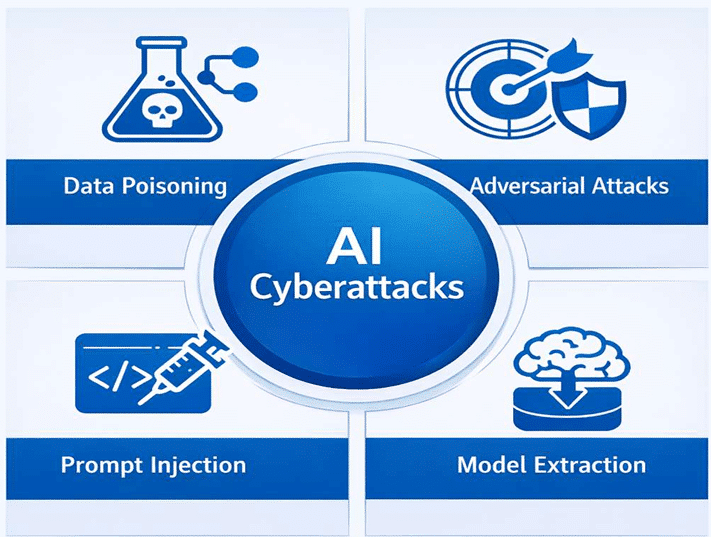
Common AI Cyberattacks
Artificial intelligence introduces
unprecedented attack vectors that require
increased vigilance and adapted
organizational cybersecurity
• Data Poisoning Inversion and Extraction
Attacks
• Command Injections (Prompt Injection)
• Input alteration to deceive AI decisions
Ready to secure your AI compliance?
Our team of experts is at your disposal to answer your questions, advise you on thesupport best suited to your needs, and establish a tailored program for your organization. Whether you wish to train your teams, conduct a compliance audit, or implement robust AI governance, we support you at every stage with recognized expertise and pragmatic solutions
Why Choose Us?
• Recognized legal and technical expertise.
• Holistic approach.
• Multi-language support:
• French, English, and German.
• Certifying training courses, including
AIGP.
• Tailor-made solutions


