
The European AI Act
First binding and harmonized legal framework in the world dedicated to artificial intelligence
European regulation is directly applicable in all Member States
Risk-based approach used
Objective: to reconcile innovation, safety, fundamental rights, and trust
Key Dates
April 2021
Proposition du règlement IA par la Commission européenne
December 2023
Final political adoption of the text
2024–2025
Transition phase: preparation, guidelines, authorities
August 2, 2026
Full and mandatory application in the EU
Concerned Actors
The regulation also applies to non-EU actors if the AI produces effects within the Union
Providers
Developers, publishers, and designers of AI systems
Deployers / Users
Companies and administrations using AI
Importers & Distributors
Responsible for placing systems on the market
Control Authorities
National and European supervision authorities
Obligations —Providers/suplliers
Classify the system according to risk level
Design in accordance with the requirements of the regulation
Provide technical documentation and traceability
Conducting conformity assessments prior to placing products on the market
Post-marketing
surveillance
Obligations — Deployers/Users
Use AI in accordance with its intended purpose
Put in place human supervision
Manage risks and incidents related to systems
Inform users when required
ISO/IEC 42001 – AI management system
The ISO/IEC 42001 standard provides a structured framework for AI system governance, facilitating risk management, documentation, and continuous improvement
It represents a relevant methodological starting point, but does not in itself constitute proof of legal compliance with the AI regulation
Obligations — Importers & Distributors
Cooperate with the authorities during
inspections
Inform users when required
Regarding individuals
The AI Regulation does not apply to natural persons using an AI system for strictly personal and non professional purposes
An individual may be classified as a deployer when their
use exceeds the private sphere
What will change from August 2, 2026
Mapping
Requirement to identify and classify AI systems by risk level
Integrated compliance
Integrate AI in accordance with GDPR, cybersecurity, and data governance requirements
Responsibility
Increased responsibilities for user companies
Transparency
Enhanced information and documentation requirements for high risk AI (mainly established by the supplier prior to placing on the market or putting into service)
Sanctions
Significant financial penalties of up to 7% of global turnover or €35 million in the event of non-compliance
Risk-based approach — Four levels
The diagram shows the risk hierarchy and the main implications for each level.
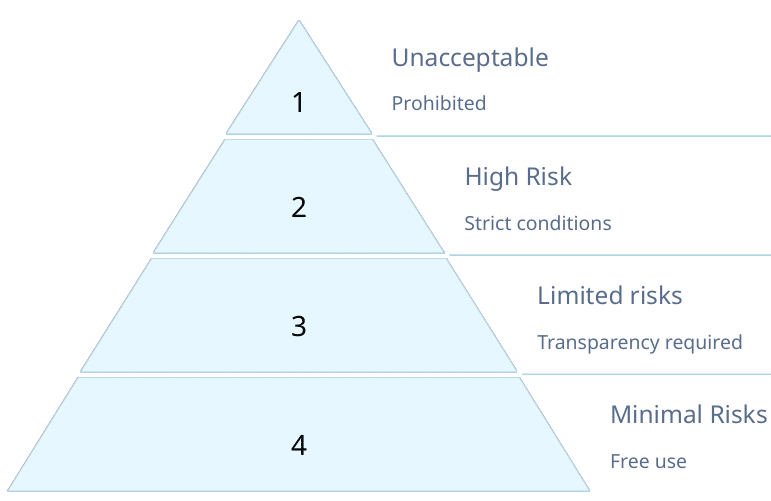
Details by risk level
Unacceptable
• Behavioral manipulation (AI that analyzes your emotions and adapts messages to push you to buy something without you realizing it)
• Exploitation of vulnerabilities.
→ • Mass biometric recognition (permanent surveillance of crowds without any specific legal reason)
Prohibited
High risk
• Recruitment (AI that sorts resumes or ranks candidates for a position)
• Healthcare (AI that assists in making medical diagnoses)
• Education (a system that ranks students according to their performance)
• Justice (AI that helps estimate the risk of recidivism)
• Essential services permitted under strict conditions (data governance, human
supervision, documentation).
Limited risk
• Chatbots,
• content generators
→primary obligation of transparency (informing the user)
Minimal risk
• Office AI, games,
• filters,
→simple recommendations
free use, without specific obligations
Impact on businesses & next steps
• A new layer of compliance to anticipate now
• Convergence of GDPR, AI, cybersecurity, and risk governance
• A key role for lawyers, DPOs, and compliance officers
• An increase in AI audits and controls


