
August 2026: Is your company ready for the global implementation of the AI Act?
It’s February 2026. For executives and compliance officers, the clock is ticking. In exactly six months, the European technology landscape will reach a historic milestone: the obligations relating to so-called “High Risk” AI systems (covered by Annex III of the AI Act) will become fully enforceable.
Far from being a mere administrative formality, this deadline marks the convergence of two pillars of digital law: data protection (GDPR) and algorithmic system security.
AIPD-AIDF Convergence: Towards a Unified Impact Assessment
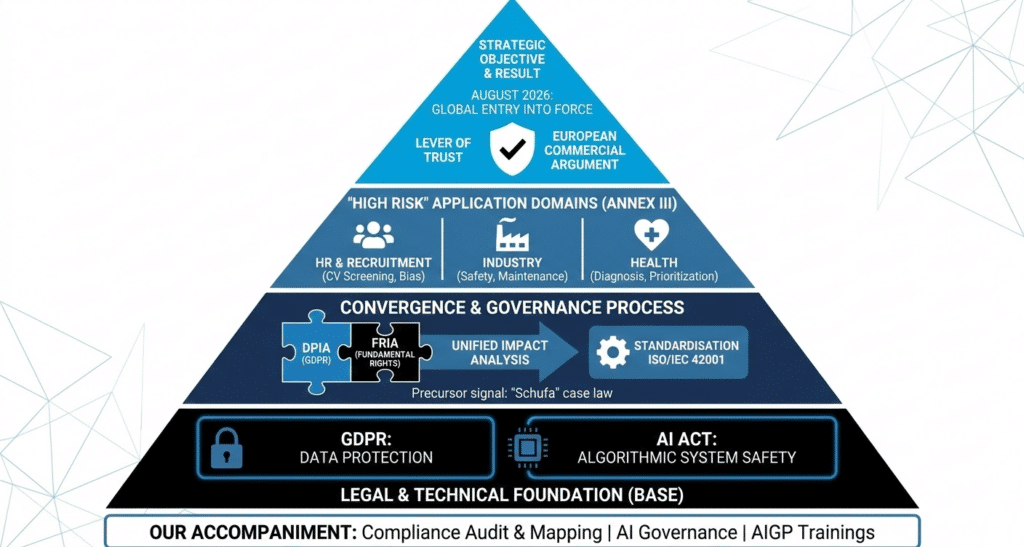
The deployment of AI can no longer be done in silos. The AI Act introduces the FRIA (Fundamental Rights Impact Assessment). To ensure that your tool complies with non-discrimination, freedom of expression, and workers’ rights. It overlaps with the DPIA , which your DPOs already informed. Instead of risking burnout by managing parallel workflows, seize the opportunity to integrate your compliance framework and maintain operational speed.
Sectors under close scrutiny
Certain areas are at the forefront of this transformation. The AI Act does not judge the technology, but rather its use:
- HR & Recruitment, with algorithms for sorting resumes or performance rating, are now scrutinized to avoid any discriminatory bias.
- Industries, where product safety and critical predictive maintenance must meet CE marking standards.
- In the healthcare sector, where patient prioritization and diagnostic assistance are subject to extremely rigorous technical validation frameworks.
The “Schufa” case law: An early warning sign
The CJEU ruling on Schufa Holding AG (C-634/21) has already paved the way. By reclassifying certain automated rating systems as falling under Article 22 of the GDPR, the European Court of Justice has reiterated that many tools used in business were already, in fact, considered “high risk.” The AI Act now complements this legal framework by adding requirements for technical documentation, traceability, and post-market surveillance.
AI-generated image
Given this complexity, compliance should be seen as a lever for building trust with your customers and partners. We support you in this transition through:
- Compliance audit and mapping: Identify which systems within your infrastructure are “high risk.”
- AI Governance & Standardization: Align with the ISO 42005 standard to structure your AI management system.
- AIGP Training: Certify your teams to master the challenges of data protection applied to artificial intelligence.
Did you know? Compliance is not just a barrier. Certified and transparent AI is now a powerful selling point in an increasingly demanding European market.


